Deal Analysis · 7 min read · Updated June 2026
Deal Analysis 101: Cap Rate, Cash-on-Cash, and NOI Explained
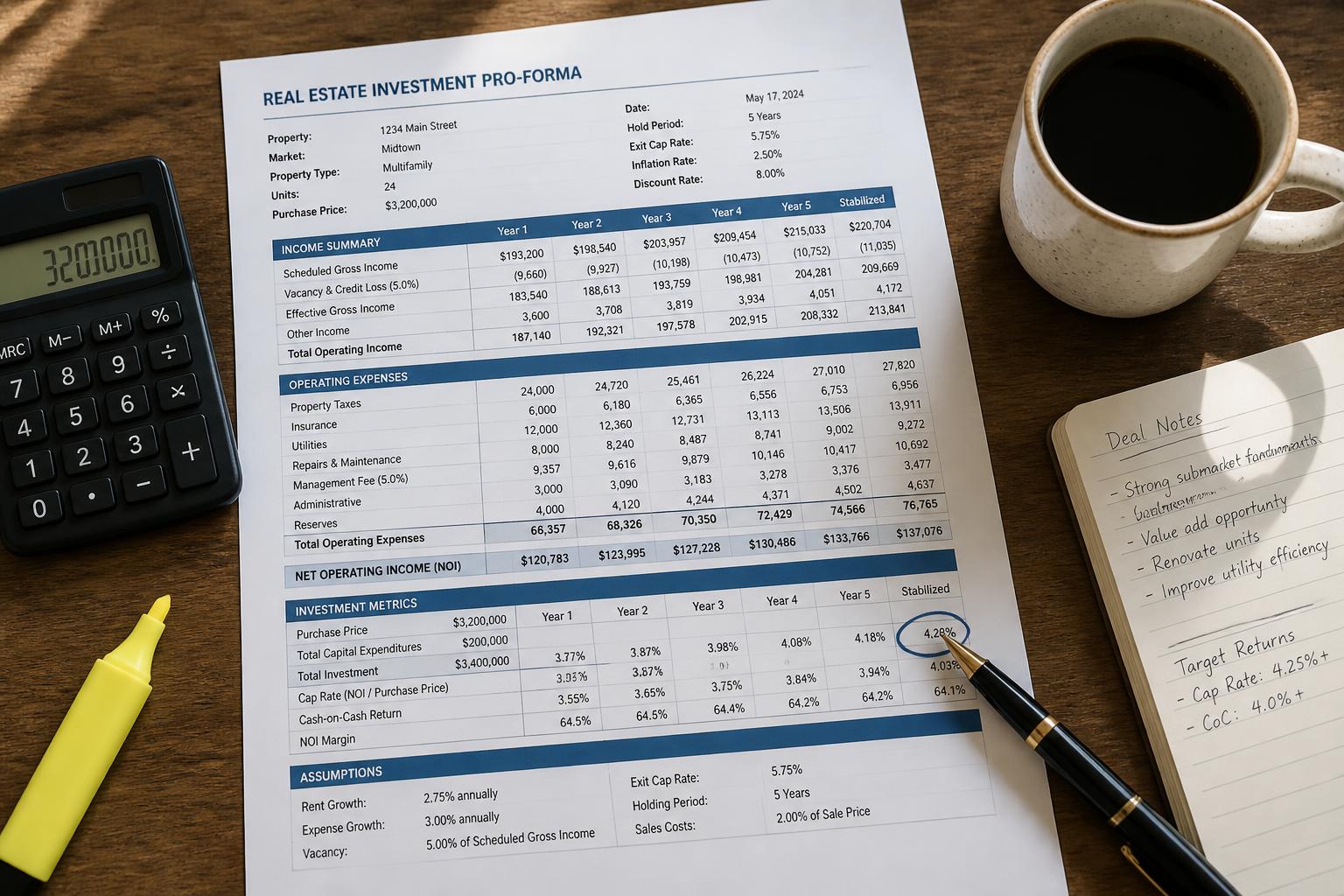
If you remember three numbers when evaluating any income-producing property, make them net operating income (NOI), cap rate, and cash-on-cash return. Together they tell you what the property earns, what it's worth to the market, and what it returns to you personally.

Net Operating Income (NOI)
NOI is gross rental income minus all operating expenses — taxes, insurance, management, repairs, utilities, and reserves — but before debt service. It's the property's earnings, independent of how you financed it.
Treat NOI as your truth serum. Inflated rent assumptions or missing expenses are the most common reason a deal looks great on paper and disappoints in practice.
Cap Rate
Cap rate = NOI ÷ purchase price. It's how the market prices a property as if you paid all cash. A 6% cap on a $1M building means $60K NOI.
Cap rate is most useful for comparing similar assets in the same submarket. Cap rates compress in stronger markets and expand in weaker ones — they're a snapshot of risk and demand, not a universal goal.
Cash-on-Cash Return
Cash-on-cash = annual pre-tax cash flow ÷ total cash invested. It tells you what your money is actually doing after debt service.
Most Texas investors target 6–10% cash-on-cash on stabilized rentals and higher on value-add. Anything under your savings account is a project, not an investment.
Next read: How to Buy Your First Rental Property in San Antonio
A worked example
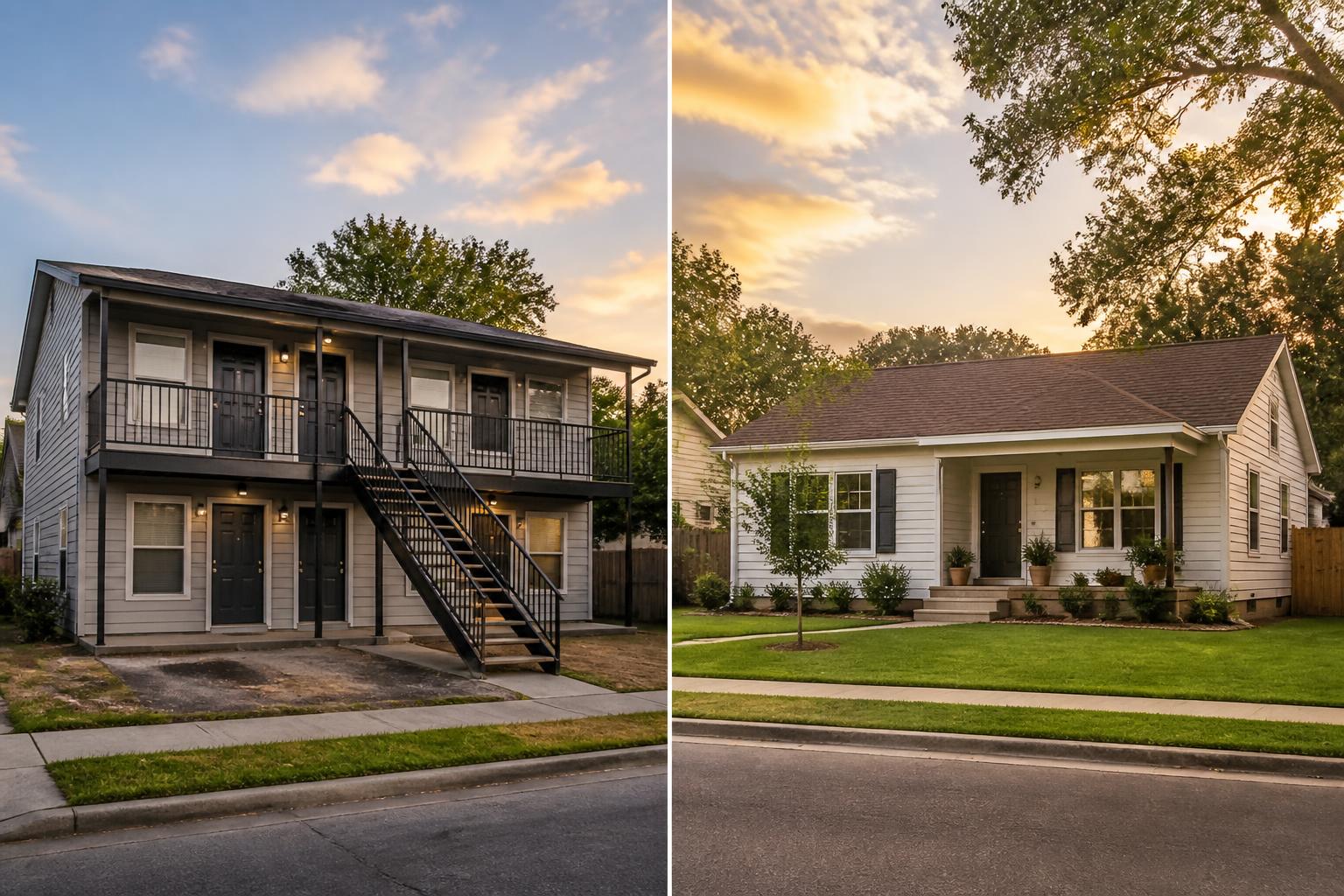
A $300K duplex with $36K gross rent, $14K operating expenses, and a $240K loan at 7.5% (P&I ≈ $20K/yr) yields $22K NOI, a 7.3% cap, and roughly $2K of annual cash flow — about 3% cash-on-cash on $66K invested. Stabilized but not exciting.
Push rents to $42K and expenses to $15K and NOI rises to $27K, the cap to 9%, and cash-on-cash to 11%. That delta is where value-add deals are made.
Key takeaways
What to remember.
- NOI = real earnings. Don't skip expenses to make a deal work.
- Cap rate is for comparison within a submarket, not a global benchmark.
- Cash-on-cash is the number that actually matters to your portfolio.
- Small changes in rent and expenses move all three numbers fast.
FAQs
Frequently asked questions.
What's a good cap rate in Texas?
It depends entirely on the asset and submarket. San Antonio small multifamily often trades 5.5–7.0% caps in 2026; self-storage 6.5–8.0%; rural land has no meaningful cap rate. Compare within a category, not across.
Is cap rate or cash-on-cash more important?
Cap rate compares the property to the market; cash-on-cash compares the deal to your other uses of capital. Both matter for different decisions.
Should I include vacancy in NOI?
Yes — always underwrite to economic occupancy, not 100%. A 5–8% vacancy assumption is reasonable for most San Antonio rentals.